Understanding and Supporting Individuals with Dyslexia: A Comprehensive Guide
Dyslexia is a common learning difference affecting a person’s ability to read, write, and spell. It’s crucial to remember it doesn’t reflect intelligence, but rather a different way the brain processes information. With proper support, individuals with dyslexia can flourish in all aspects of life.
This blog delves into understanding and supporting individuals with dyslexia and draws upon the specific experiences of Daniel Wysocki Ed.S., and his school psychology background. We’ll explore key aspects, from common challenges to practical strategies for success, with a focus on real-world classroom examples.
- What is Dyslexia?
Dyslexia is a specific learning difference characterized by difficulty with accurate and/or fluent word recognition, and poor spelling and decoding abilities. These difficulties typically arise from a deficit in the language’s phonological component, the sound system. - Signs and Symptoms:
Common signs include difficulty with:- Blending sounds to form words (phonemic awareness)
- Matching letters to sounds (phonics)
- Reading fluency
- Spelling
- Decoding unfamiliar words
Real-World Classroom Example:
Imagine a student named Sarah in the third grade. Sarah is a bright and curious student who participates actively in class discussions. However, she struggles during reading time. She stumbles over unfamiliar words, takes a long time to sound them out, and often confuses similarly sounding letters (b/d, p/q). Her written work may contain misspelled words, and her sentences might lack proper grammar and structure. These signs could indicate that Sarah has dyslexia.
Supporting Individuals with Dyslexia
- Emotional Support:
Building confidence and self-esteem is vital. Create a positive and encouraging environment to help them overcome challenges. - Open Communication:
Open communication is key to understanding specific needs and preferences. Listen actively and work together to find solutions.
Strategies for Success:
- Multisensory Learning:
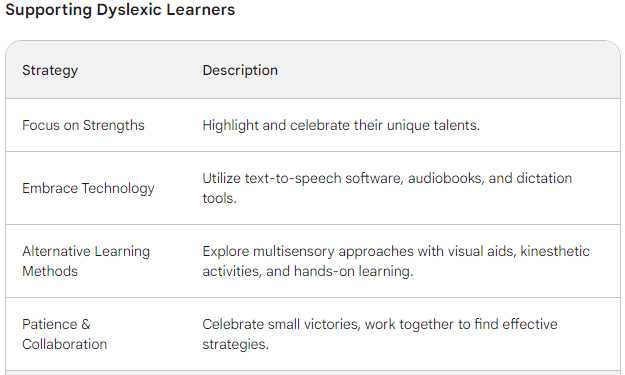
Engage multiple senses (visual, auditory, kinesthetic) during learning. This can involve using manipulatives, like letter blocks or clay, to form letters while sounding them out. Audiobooks can support reading comprehension, while visual aids can help break down complex information. - Assistive Technology:
Explore assistive technology, such as text-to-speech software and audiobooks, to aid with reading and writing. Many apps and online resources are specifically designed for individuals with dyslexia. - Structured Instruction:
Structured, explicit instruction tailored to individual needs can significantly improve reading and writing skills. Break down complex tasks into smaller, manageable steps and provide clear and consistent instruction. - Focus on Strengths: Recognize and celebrate strengths beyond reading and writing. Many people with dyslexia excel in areas like creativity, problem-solving, and spatial reasoning. Play to these strengths by incorporating hands-on activities, group projects, and opportunities for artistic expression.
- Classroom Examples:
- Provide graphic organizers for note-taking to help visualize information.
- Allow students to use audiobooks or text-to-speech software during independent reading time.
- Offer alternative assessments that don’t rely solely on written tests, such as oral presentations or creative projects.
- During group activities, assign roles that leverage individual strengths. For instance, a student with strong visual-spatial skills can create charts or diagrams for the group.
Finding Help
If you suspect someone has dyslexia, seeking professional help is crucial. Look for qualified tutors or evaluators who specialize in dyslexia, such as Daniel Wysocki Ed.S.
Remember: With a supportive environment, effective strategies, and a positive attitude, individuals with dyslexia can achieve great things. By implementing these strategies and fostering a positive learning environment, we can empower individuals with dyslexia to reach their full potential.