Short answer:
No. ADHD is the set of observable characteristics of an individual resulting from the interaction between genetics and the environment.
Long answer:
ADHD is evident early in development and produces impairments of personal, social, academic, or occupational function. It is a neurodevelopmental disorder defined by impairing levels of inattention, disorganization, and/or hyperactivity-impulsivity. Neurodevelopmental disorders are a group of disorders that affect the development of the nervous system, leading to abnormal brain function which may affect emotion, learning ability, self-control, and memory. The effects of neurodevelopmental disorders tend to last for a person’s lifetime. According to the CDC, “Research does not support the popularly held views that ADHD is caused by eating too much sugar, watching too much television, parenting, or social and environmental factors such as poverty or family chaos.” While it is well documented the underlying biological components of ADHD are caused by inherited genetics and considered a byproduct of one’s “family tree”, symptoms are influenced by the environment. The environmental input and the effect on behaviors is where the long answer gets complicated.
We learn through many unique and individual processes, but one well-known and understood process is conditioning. Conditioning is when a stimulus results in an increasingly regular response. This will often rely on either positive or negative reinforcement. Reinforcement increases the likelihood of a response, and punishment decreases the likelihood of a response. This can be seen in the table credited to BCCampus Open Publishing.
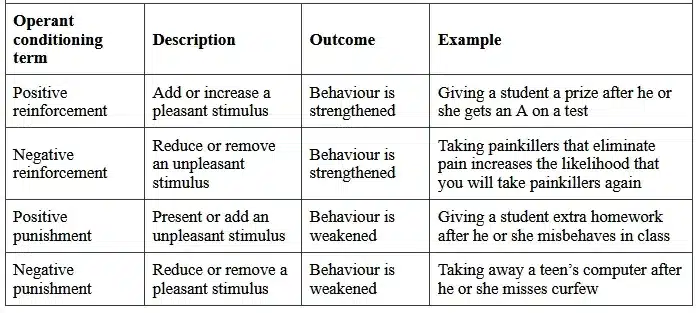
If you take the concept of conditioning and apply another process, “generalization,” you can conclude that a child might respond to situations in the real world similarly to video games and expect similar results. This means you would take the learned behaviors from the video game (fast responses, high stimulation, immediate rewards) and apply these expectations to everyday life. Combining these two concepts it is possible to see that the interactions we have within the virtual world may translate to the real world.
Luckily, learning is not this simple. Everyday human environments feature uncertain, changing, and especially open-ended situations. Comparing a simple learned human response in a video game translating to the real world assumes we are no more sophisticated than pigeons trained to peck at a target and be rewarded with food when the task is completed correctly. We have advanced and complicated our learning processes. We have the ability to think about different outcomes and make deliberate choices. This dispels the myth that a child can be trained into having ADHD. ADHD is persistent, stable, pervasive and results from underlying biological factors. Additionally, human learning, behavior and decision making is too complicated to be easily caused by video games, but video games can change behavior. Behavior is the way we act, and this will be influenced by what is in our environment, what is not, our thoughts, our biology, and more variables than can be written. Even if you have absolute control over all variables and are attempting to conduct a psychological experiment there will still be variables out of your control, and maybe some you do not even know about.
Q. How do video games change behaviors?
A. By introducing new information and creating new patterns of emotional response. However, this is no different from utilizing social media, watching TV, or any other activity. All these provide us with new information to be assimilated and processed.
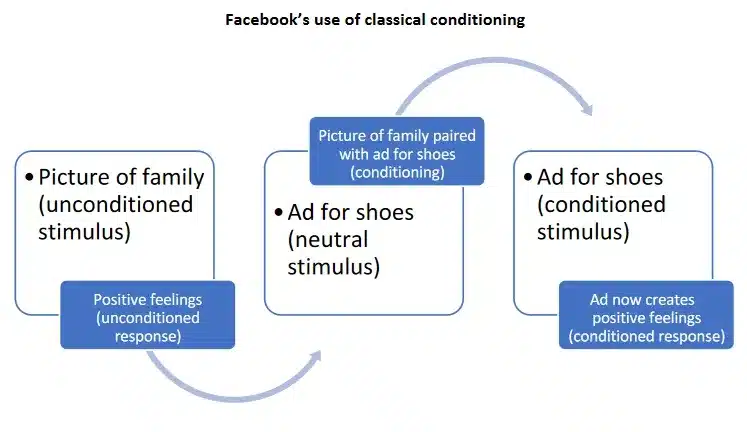
Q. How does this tie into conditioning?
A. The easiest example is Facebook. It applies the classical conditioning principle of learning through association. The conditioned stimulus occurs before the unconditioned stimulus, and then the conditioned stimulus acts as a type of signal or cue for the unconditioned stimulus. It is how social media influences people to be more likely to make purchases based on their suggestions.
Video games or any constant electronic media is going to change behaviors because it is providing new information to be integrated into our existing understanding of the world. This is no different than the use of social media, watching TV, or browsing the internet. However, there should always be balance and, for children, careful content monitoring of the media. Certain interactions online or within the context of the electronic medium are going to invoke certain responses. We do not know the possible impact of having electronic media beamed into our brain every minute of every day, because this is a relatively new phenomenon. Even with all the changes in the availability of fast response electronics, ADHD pre-dates the invention of the video game. In 1968, the second edition of the Diagnostic and Statistical Manual of Mental Disorders included “hyperkinetic impulse disorder,” the first-time symptoms now known as ADHD are recognized by the American Psychiatric Association (APA). This is long before any video game culture and indicates ADHD is not a new diagnosis.
Summary:
- ADHD has a genetic component that cannot be created through the use of electronic media.
- Exposure to any information is going to result in learning and new behaviors will be displayed.
- Balance is needed with any use of screens to ensure they are not creating imbalances in health, social activities or education.
Article by WPS